20d
Intelligence Bureau comments on P.C. Joshi's memorandum — Jamshedpur, Cawnpore, and the Morazha case
Governmentnone marked on this page
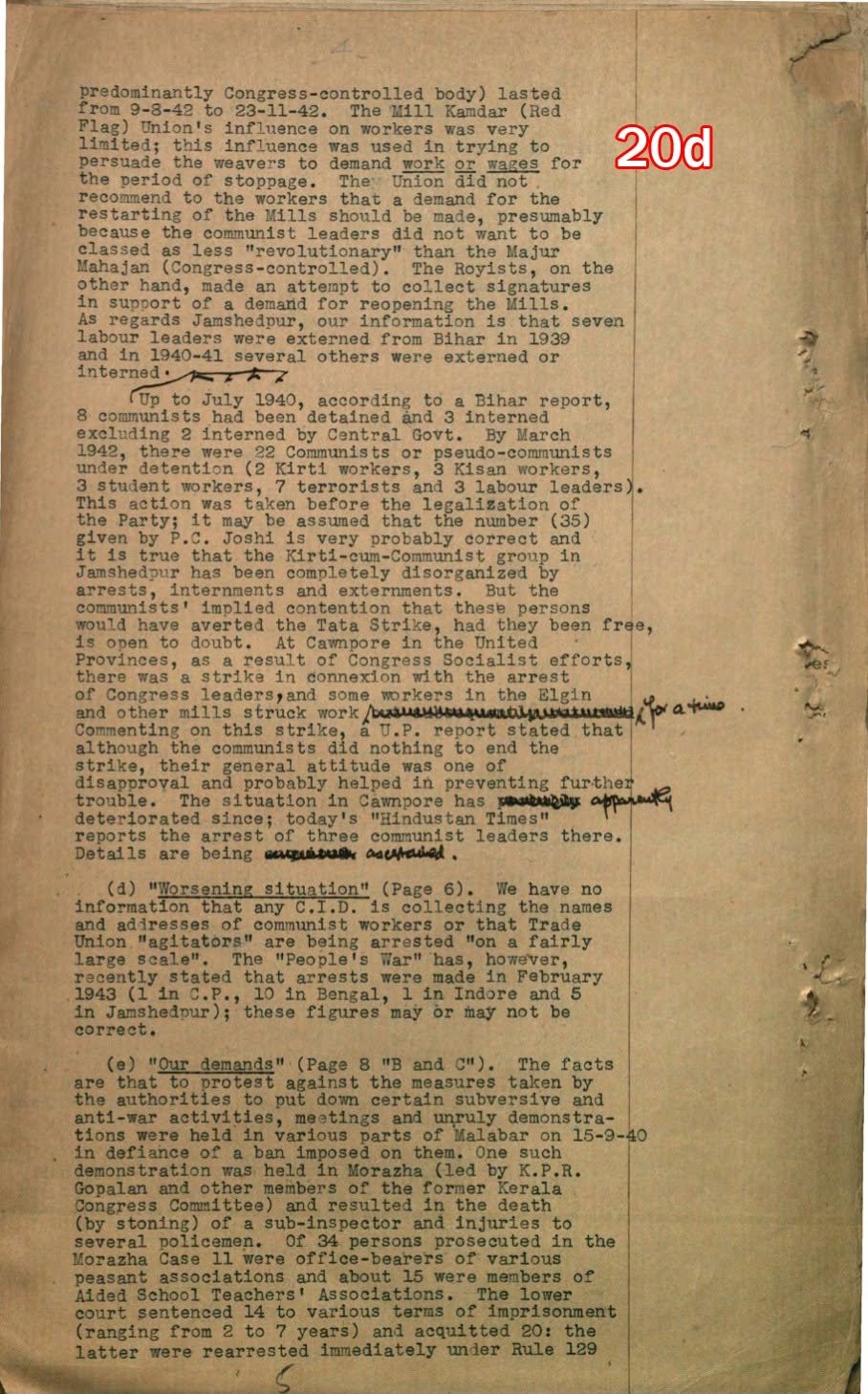
Contrast-enhanced derivative. The scan shown by default is the unmodified original, so any reading can be checked honestly.
Transcript verbatim
                                4

predominantly Congress-controlled body) lasted
from 9-8-42 to 23-11-42. The Mill Kamdar (Red
Flag) Union's influence on workers was very
limited; this influence was used in trying to
persuade the weavers to demand work or wages for
the period of stoppage. The Union did not
recommend to the workers that a demand for the
restarting of the Mills should be made, presumably
because the communist leaders did not want to be
classed as less "revolutionary" than the Majur
Mahajan (Congress-controlled). The Royists, on the
other hand, made an attempt to collect signatures
in support of a demand for reopening the Mills.
As regards Jamshedpur, our information is that seven
labour leaders were externed from Bihar in 1939
and in 1940-41 several others were externed or
interned.

        Up to July 1940, according to a Bihar report,
8 communists had been detained and 3 interned
excluding 2 interned by Central Govt. By March
1942, there were 22 Communists or pseudo-communists
under detention (2 Kirti workers, 3 Kisan workers,
3 student workers, 7 terrorists and 3 labour leaders).
This action was taken before the legalization of
the Party; it may be assumed that the number (35)
given by P.C. Joshi is very probably correct and
it is true that the Kirti-cum-Communist group in
Jamshedpur has been completely disorganized by
arrests, internments and externments. But the
communists' implied contention that these persons
would have averted the Tata Strike, had they been free,
is open to doubt. At Cawnpore in the United
Provinces, as a result of Congress Socialist efforts,
there was a strike in connexion with the arrest
of Congress leaders, and some workers in the Elgin
and other mills struck work [struck-over words] {ms. insertion: for a time}.
Commenting on this strike, a U.P. report stated that
although the communists did nothing to end the
strike, their general attitude was one of
disapproval and probably helped in preventing further
trouble. The situation in Cawnpore has [struck: markedly] {ms. insertion: apparently}
deteriorated since; today's "Hindustan Times"
reports the arrest of three communist leaders there.
Details are being [struck-over word] {ms. insertion: ascertained}.

        (d) "Worsening situation" (Page 6). We have no
information that any C.I.D. is collecting the names
and addresses of communist workers or that Trade
Union "agitators" are being arrested "on a fairly
large scale". The "People's War" has, however,
recently stated that arrests were made in February
1943 (1 in C.P., 10 in Bengal, 1 in Indore and 5
in Jamshedpur); these figures may or may not be
correct.

        (e) "Our demands" (Page 8 "B and C"). The facts
are that to protest against the measures taken by
the authorities to put down certain subversive and
anti-war activities, meetings and unruly demonstra-
tions were held in various parts of Malabar on 15-9-40
in defiance of a ban imposed on them. One such
demonstration was held in Morazha (led by K.P.R.
Gopalan and other members of the former Kerala
Congress Committee) and resulted in the death
(by stoning) of a sub-inspector and injuries to
several policemen. Of 34 persons prosecuted in the
Morazha Case 11 were office-bearers of various
peasant associations and about 15 were members of
Aided School Teachers' Associations. The lower
court sentenced 14 to various terms of imprisonment
(ranging from 2 to 7 years) and acquitted 20: the
latter were rearrested immediately under Rule 129