20c
Intelligence Bureau comments on P.C. Joshi's memorandum
Governmentnone marked on this page
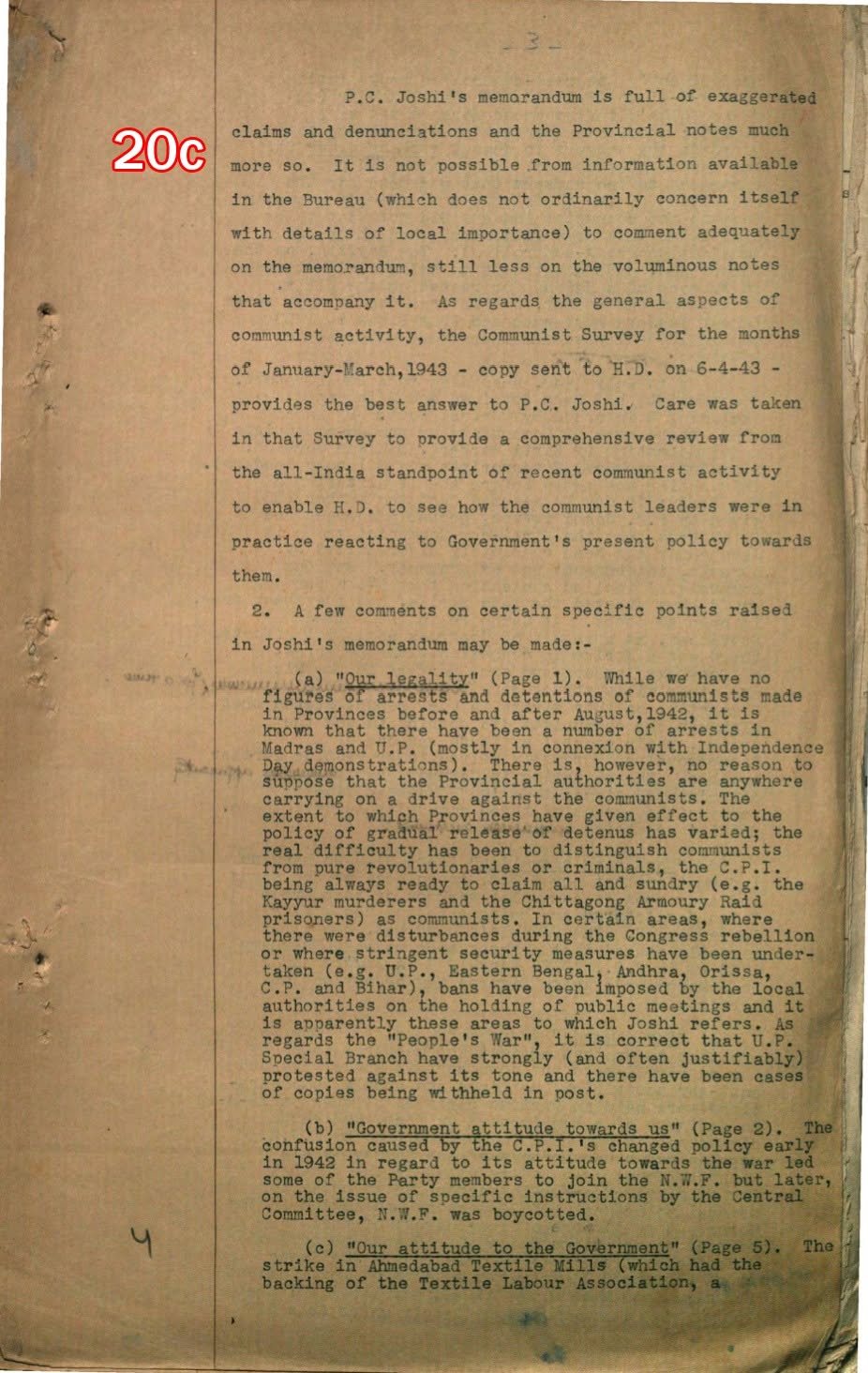
Contrast-enhanced derivative. The scan shown by default is the unmodified original, so any reading can be checked honestly.
Transcript verbatim
                                -3-

        P.C. Joshi's memorandum is full of exaggerated
claims and denunciations and the Provincial notes much
more so. It is not possible from information available
in the Bureau (which does not ordinarily concern itself
with details of local importance) to comment adequately
on the memorandum, still less on the voluminous notes
that accompany it. As regards the general aspects of
communist activity, the Communist Survey for the months
of January-March, 1943 - copy sent to H.D. on 6-4-43 -
provides the best answer to P.C. Joshi. Care was taken
in that Survey to provide a comprehensive review from
the all-India standpoint of recent communist activity
to enable H.D. to see how the communist leaders were in
practice reacting to Government's present policy towards
them.

        2. A few comments on certain specific points raised
in Joshi's memorandum may be made:-

        (a) "Our legality" (Page 1). While we have no
figures of arrests and detentions of communists made
in Provinces before and after August, 1942, it is
known that there have been a number of arrests in
Madras and U.P. (mostly in connexion with Independence
Day demonstrations). There is, however, no reason to
suppose that the Provincial authorities are anywhere
carrying on a drive against the communists. The
extent to which Provinces have given effect to the
policy of gradual release of detenus has varied; the
real difficulty has been to distinguish communists
from pure revolutionaries or criminals, the C.P.I.
being always ready to claim all and sundry (e.g. the
Kayyur murderers and the Chittagong Armoury Raid
prisoners) as communists. In certain areas, where
there were disturbances during the Congress rebellion
or where stringent security measures have been under-
taken (e.g. U.P., Eastern Bengal, Andhra, Orissa,
C.P. and Bihar), bans have been imposed by the local
authorities on the holding of public meetings and it
is apparently these areas to which Joshi refers. As
regards the "People's War", it is correct that U.P.
Special Branch have strongly (and often justifiably)
protested against its tone and there have been cases
of copies being withheld in post.

        (b) "Government attitude towards us" (Page 2). The
confusion caused by the C.P.I.'s changed policy early
in 1942 in regard to its attitude towards the war led
some of the Party members to join the N.W.F. but later,
on the issue of specific instructions by the Central
Committee, N.W.F. was boycotted.

        (c) "Our attitude to the Government" (Page 5). The
strike in Ahmedabad Textile Mills (which had the
backing of the Textile Labour Association, a