19d
"Memo on Political-Practical Activities in Kerala" — obstruction by police and bureaucracy; the production front
Communist Party
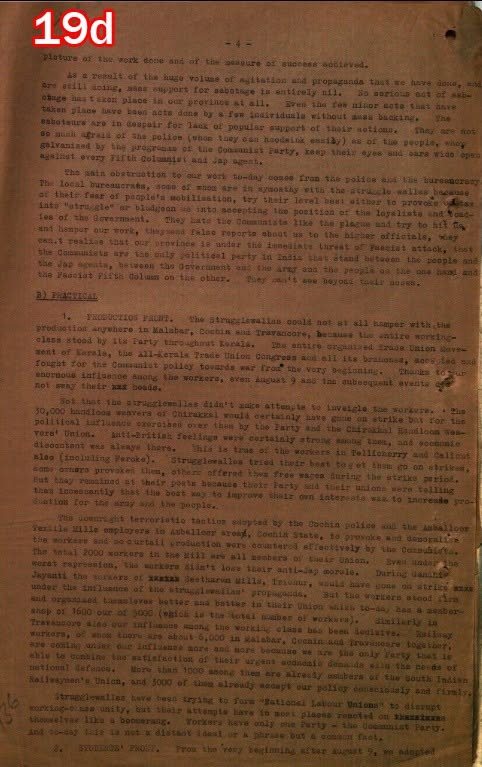
Contrast-enhanced derivative. The scan shown by default is the unmodified original, so any reading can be checked honestly.
Transcript verbatim
                                - 4 -

picture of the work done and of the measure of success achieved.

        As a result of the huge volume of agitation and propaganda that we have done, and are still doing, mass support for sabotage is entirely nil. No serious act of sabotage has taken place in our province at all. Even the few minor acts that have taken place have been acts done by a few individuals without mass backing. The saboteurs are in despair for lack of popular support of their actions. They are not so much afraid of the police (whom they can hoodwink easily) as of the people, who, galvanised by the programme of the Communist Party, keep their eyes and ears wide open against every Fifth Columnist and Jap agent.

        The main obstruction to our work to-day comes from the police and the bureaucracy. The local bureaucrats, some of whom are in sympathy with the strugglewallas because of their fear of people's mobilisation, try their level best either to provoke us into "struggle" or bludgeon us into accepting the position of the loyalists and toadies of the Government. They hate the Communists like the plague and try to hit us and hamper our work, they send false reports about us to the higher officials, they can't realise that our province is under the immediate threat of Fascist attack, that the Communists are the only political party in India that stand between the people and the Jap agents, between the Government and the army and the people on the one hand and the Fascist Fifth Column on the other. They can't see beyond their noses.

B) PRACTICAL

        1. PRODUCTION FRONT. The Strugglewallas could not at all hamper with the production anywhere in Malabar, Cochin and Travancore, because the entire working-class stood by its Party throughout Kerala. The entire organised Trade Union movement of Kerala, the All-Kerala Trade Union Congress and all its branches, accepted and fought for the Communist policy towards war from the very beginning. Thanks to our enormous influence among the workers, even August 9 and the subsequent events could not sway their [struck-over word] heads.

        Not that the strugglewallas didn't make attempts to inveigle the workers. The 30,000 handloom weavers of Chirakkal would certainly have gone on strike but for the political influence exercised over them by the Party and the Chirakkal Handloom weavers' Union. Anti-British feelings were certainly strong among them, and economic discontent was always there. This is true of the workers in Tellicherry and Calicut also (including Feroke). Strugglewallas tried their best to get them to go on strikes, some others provoked them, others offered them free wages during the strike period. But they remained at their posts because their Party and their unions were telling them incessantly that the best way to improve their own interests was to increase production for the army and the people.

        The downright terroristic tactics adopted by the Cochin police and the Amballoor Textile Mills employers in Amballoor area, Cochin State, to provoke and demoralise the workers and so curtail production were countered effectively by the Communists. The total 2000 workers in the Mill are all members of their Union. Even under the worst repression, the workers didn't lose their anti-Jap morale. During [Gandhi?] Jayanti the workers of [struck-over word] Seetharam Mills, Trichur, would have gone on strike under the influence of the strugglewallas' propaganda. But the workers stood firm and organised themselves better and better in their Union which to-day has a membership of 1600 out of 3000 (which is the total number of workers). Similarly in Travancore also our influence among the working class has been decisive. Railway workers, of whom there are about 6,000 in Malabar, Cochin and Travancore together, are coming under our influence more and more because we are the only Party that is able to combine the satisfaction of their urgent economic demands with the needs of national defence. More than 1000 among them are already members of the South Indian Railwaymen's Union, and 5000 of them already accept our policy consciously and firmly.

        Strugglewallas have been trying to form "National Labour Unions" to disrupt working-class unity, but their attempts have in most places reacted on themselves like a boomerang. Workers have only one Party - the Communist Party. And to-day this is not a distant ideal or a phrase but a common fact.

        2. STUDENTS' FRONT. From the very beginning after August 9, we adopted